


Three Women, One Boat
The boat was hitched behind the LandCruiser when I pulled up at Darwin Airport to collect Rose and Trish.
There were bags, fishing gear and warm hugs in the tropical heat. Rose and I had met before, but this was the first time I had properly met Trish in person. Within hours, the three of us would be heading down the highway towards Banyan Farm, where we would share a boat for the next week and compete together in one of the Northern Territory’s most respected barramundi tournaments.
No slow introduction. No practice weekend to work each other out.
Just three women, a fully loaded vehicle and a boat pointed towards the Daly River.
Rose and Trish were trusting me with more than their fishing week. They were stepping onto my boat without really knowing how I operated as a skipper, how well I maintained my gear or how I would respond if something went wrong.
That is a big thing to place in someone else’s hands.
I felt it from the moment we met.
I wanted to find fish. Of course I did. It was the Barra Nationals.
But I also wanted them to have a good experience. They had committed their time and money to being there, and they were trusting me to get them safely up and down a river that had recently experienced the worst flood in its recorded history.
None of us fully understood how much that river had changed.
We were about to find out.
For the first time, the Women’s Recreational Fishing League had entered two all-women crews in the Barra Nationals.
I would skipper WRFL NT with Rose and Trish. Kendl would skipper WRFL NSW with Donna and Liv.
Six women. Two boats. One large camp tent that would soon be known as the Taj Mahal.
And three Barra Nats virgins.
Trish, Donna and Liv had never competed in the event before. That meant they would be presented with the traditional yellow tutu on Orientation Day, better known as O-Day.
The rules of the tutu are simple.
It stays on until you land a point-scoring barramundi of at least 40 centimetres during competition time.
Some tutus come off quickly. Others hang around for most of the week. On occasions, an angler has returned the following year still wearing theirs, determined to finish what they started.
It may look like a bit of fun, and it is, but there is real pressure hidden in all that tulle.
First, though, we had to reach the river.
A River Rewritten
We arrived at Banyan Farm on the evening of Friday 29 May.
The Barra Nationals would begin with O-Day on Monday 1 June, but this was not going to be a normal lead-up.
In March, the Daly River at Nauiyu had peaked at 16.42 metres, exceeding the previous record of 16.25 metres set during the 1998 flood. Around 450 residents had been evacuated to Darwin as water rose over the community and swallowed homes to their rooftops.
By the time we arrived, the water had dropped.
The damage had not.
Wooliana Road no longer reached the places it once had. Part of it had collapsed into the river when the bank was torn away, leaving the public boat ramp inaccessible.
At Banyan Farm, the flood had driven so much silt into the opening between the high riverbanks that the boat ramp gap had been filled. The buildup was at least ten metres high. Work was still underway to clear a path back to the water.
We had hoped to do some preparation before the event, but the Daly River region had been declared an emergency zone. There had been no normal reconnaissance and no chance to rely on the knowledge built over previous years.
We would have to learn the river again from the boat.
When we finally travelled through the Wooliana stretch, the scale of the flood became impossible to ignore.
Cars were left hanging near the broken edge where the ground beneath them had disappeared. Houses sat damaged and exposed above places where the road and riverbank had once been.
I had fished the Daly many times.
I knew its bends, its high banks and the stretches where I had travelled safely in previous years.
But the river in front of us no longer matched the river stored in my memory.
Old tracks remained on the sounder, but they could not be trusted in the same way. Sandbars had shifted. New ones had formed. Timber had moved, and submerged hazards sat in water that had once been clear passage.
The Daly had not simply risen and dropped again.
It had rewritten itself.
O-Day
By Monday morning, it was time to begin working it out.
O-Day gave us the chance to check travel times, test different areas and see where the fish might be holding before the competition points started.
I do not fish on O-Day.
It is pure superstition.
If I am only going to catch one barra all week, I do not want to waste it before the points count. I want that fish during competition time.
Rose and Trish were welcome to fish, though. Interstate anglers do not often have the chance to fish the Daly, and I was not going to ask them to sit on their hands because of my superstition.
For Trish, it was a completely new fishery.
She was an experienced tournament angler from South Africa, but she had never fished the Daly River. She had never caught a barramundi either.
That changed on O-Day.
Her first barra measured 43 centimetres. In competition time, it would have been a scoring fish.
As it came aboard, Trish recognised something familiar in the way it fought.
“Ohh, they fight similar to our tiger fish back home.”
It was her first taste of a barramundi, but it did not count towards removing the tutu. She would have to do it again once the competition began.
Over on the NSW boat, Donna caught her first legal barramundi that day too.
That evening, the three first-time competitors were presented with their yellow tutus.
The practice fish no longer mattered.
When the competition started the next morning, they would all be back at zero.
Before Day One, the three of us also talked through how things should work on the boat.
If someone hooked up, who would grab the net?
Who would clear the rods and move the gear?
Who would take the photograph?
Who would handle the app?
It was a sensible plan.
Like many sensible plans made before the fish start hitting, it lasted about half a day.
Day One: The Tutu Comes Off
Day One began with everything still unfamiliar.
A changed river. A new crew. Assigned jobs. Trish in her tutu.
Then, at 9.50 am, less than an hour after lines went in, Trish hooked up.
This was not the small O-Day barra.
This fish had weight behind it.
In the fast-flowing Daly, a barramundi does not give you much room for error. The fight can change in seconds, and every time the fish comes near the surface there is another chance for it to throw the hook.
Trish stayed connected.
Around her, the boat came alive.
Rods were moved. Space was cleared. The net was ready. Everyone shifted into whatever position was needed without stopping to ask whose assigned job it was.
The fish came within reach.
Then it was in the net.
Sixty-five centimetres of competition barramundi, safely inside the boat.
The photograph was taken. The fish was submitted through the app.
Trish had her first point-scoring barra at the Barra Nationals.
She was shaking.
For a moment, there was only relief.
Then she grabbed the yellow tutu, ripped it off and swung it above her head for anyone nearby to see.
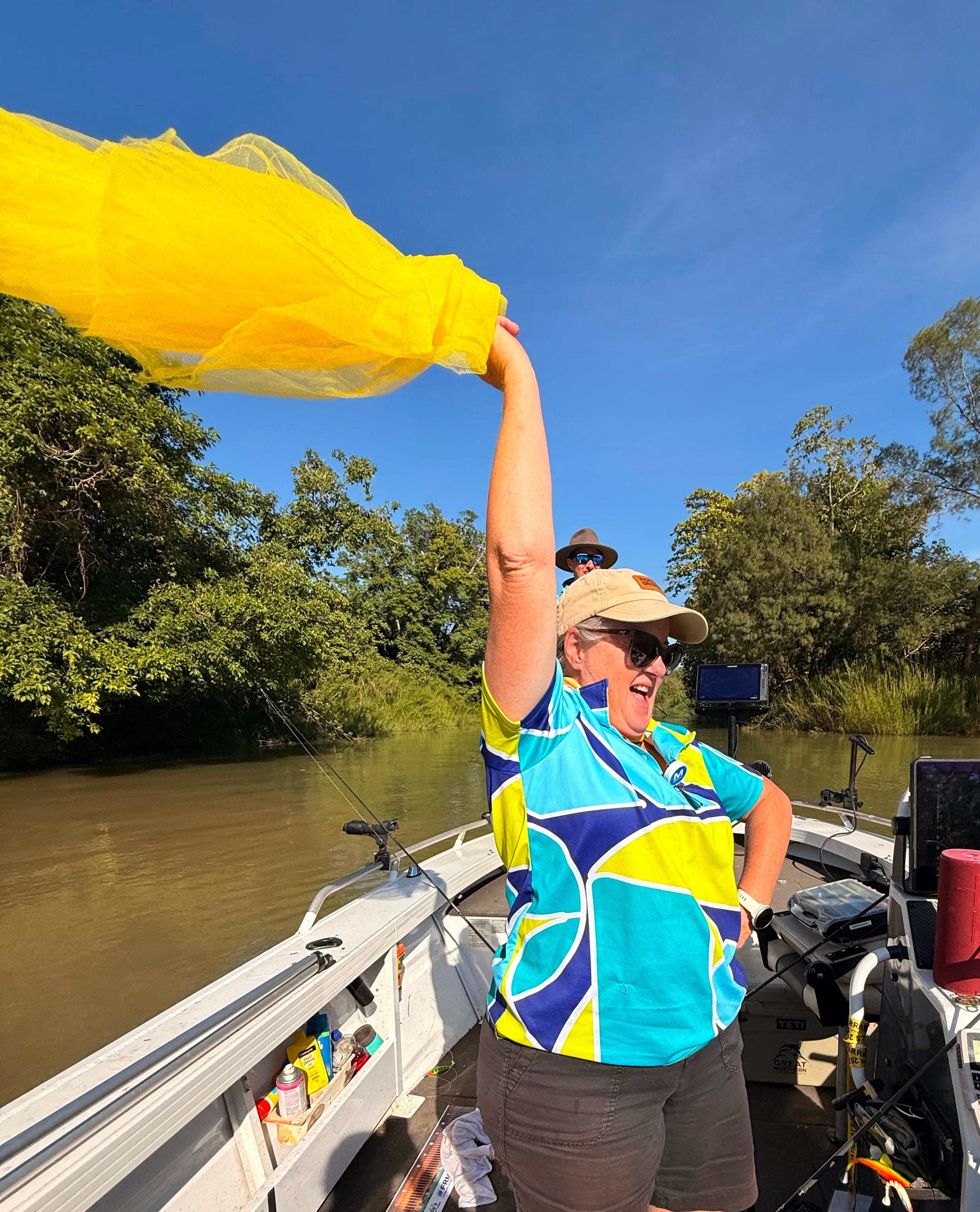
The tutu was gone.
The tournament angler returned almost immediately.
The relief became a new instruction.
Let’s get more on the board.
I was beyond happy for her.
I was relieved too, if I am honest.
As skipper, I had wanted that fish for Trish. She had travelled across the country, stepped onto the boat of someone she barely knew and taken on a river unlike anything she had fished before.
Now, before ten o’clock on the first morning, she had done it.
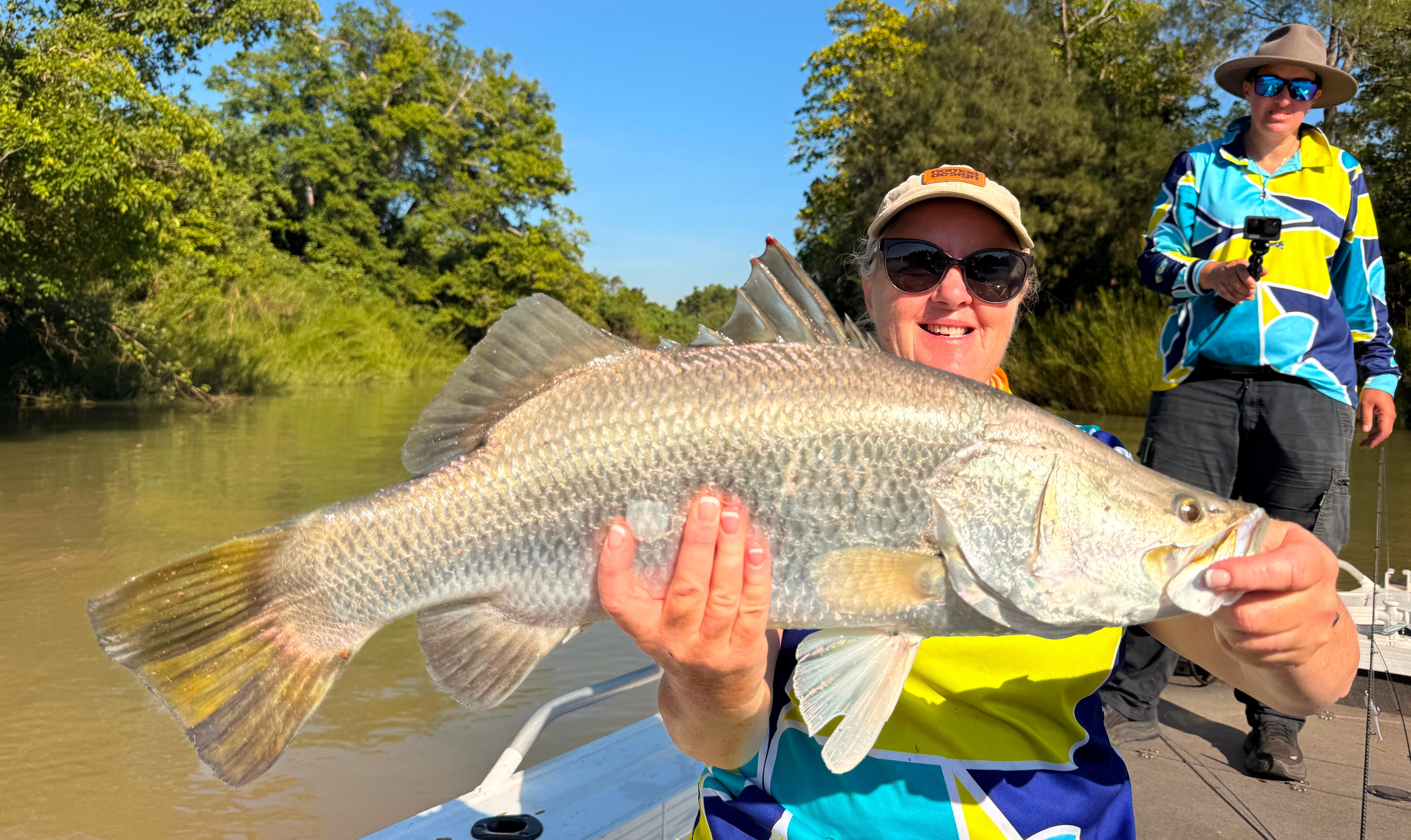
She had caught the fish herself, but there is a special kind of pride in being the skipper who gets to watch that moment unfold.
Continued in - Part Two: Into the Fog.
Rather follow along on social media? Find EmmaLou Fishing on Facebook and Instagram.